Patient information · Assessment and treatment
The Slavicek concept: occlusion, movement and treatment planning
A tooth’s shape affects how it meets the opposing tooth when the jaw closes and moves. Austrian prosthodontist Rudolf Slavicek’s concept connects the design of these contacts with individual movement, jaw structure and muscle function. When designing restorations, these records help the dentist and technician shape the teeth and check how they will meet during chewing.
What distinguishes the approach?
Slavicek considered the chewing system in motion: teeth participate in chewing, swallowing and speech alongside joints and muscles. When restoring teeth, the dentist studies how the patient chews and moves the jaw, then uses those movements to help design the tooth surfaces.
VieSID, the Vienna School of Interdisciplinary Dentistry, develops education based on his work. Its teaching connects clinical analysis, instrumental diagnostics and laboratory modelling. The concepts below explain how those parts fit together.
Reference position: a starting point for comparison
To compare movement recordings, we need to start from the same lower-jaw position each time. In the Slavicek concept, this is called the reference position.
Your habitual bite is the position in which you normally bring your teeth together. If it differs from the reference position, I assess that difference alongside your symptoms and the condition of your muscles and joints. The reference position is used for diagnostic recordings; I choose a treatment position based on the examination findings.
Sequential guidance: relating tooth shape to movement
Static occlusion describes contacts on closure; dynamic occlusion describes how they change as the jaw moves forward or sideways. Tooth cusps and slopes form the surfaces involved in that movement. A restoration may therefore appear suitable when the teeth are together yet interact differently during movement.
Sequential guidance is a characteristic concept in Slavicek’s approach to modelling occlusion. In this scheme, the inclination of guiding surfaces increases progressively from posterior towards anterior teeth. As the jaw moves sideways, the teeth participating in contact change and posterior teeth separate sequentially. This is a design principle discussed by the dentist and technician during restorative planning.
When checking the proposed restorations, I assess both closure and jaw movement. As the jaw moves sideways, for example, I look at which tooth surfaces stay in contact and which separate. I compare those contacts with your individual movement records.
Bringing form, position and movement together
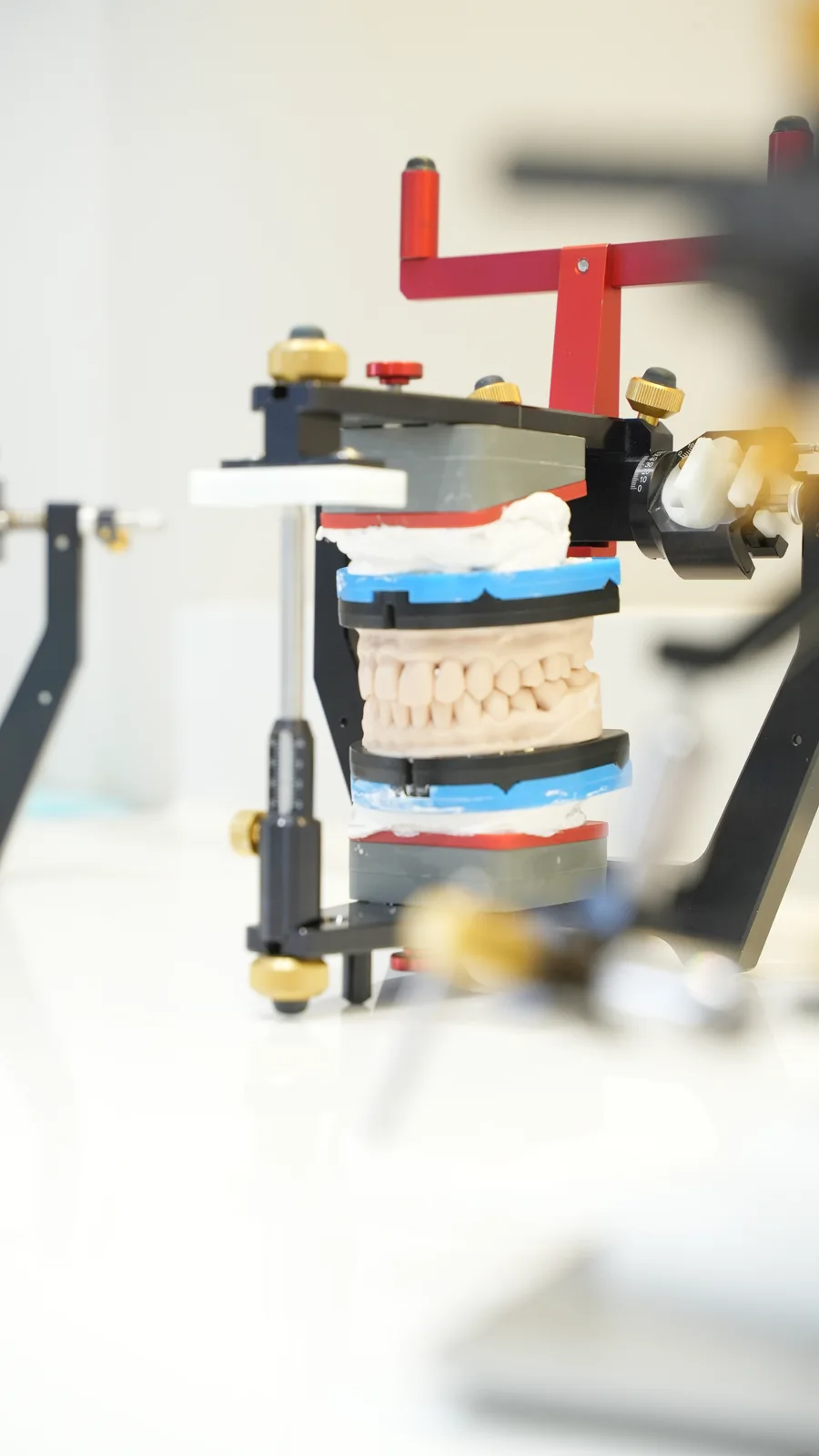
Scans capture tooth shape. Transfer records allow the models to be mounted in an articulator in relation to anatomical landmarks. Condylography provides measurements for adjusting the device to your jaw movements. When needed, cephalometric analysis assesses the position of the teeth and jaws relative to the facial bones.
An articulator brings some of this information together in a working model. The dentist and technician can study contacts and design surfaces using the selected settings. Clinical checks remain essential: a model cannot reproduce muscle activity or every response of living tissues.
Collect comparable records
Record tooth shape and jaw position, together with examination findings and any movement measurements needed.
Create the working model
Mount the jaw models and set the articulator using the recordings.
Design and verify
Model the tooth surfaces, check how they meet and discuss how the restorations feel at the fitting appointment.
An example: rebuilding worn posterior teeth
As an illustrative example, imagine several back teeth with worn chewing surfaces. Before choosing onlays or crowns, the clinician establishes available space, remaining tissue and interaction with the opposing teeth. Where space is limited, orthodontic involvement may be discussed.
On the models, the technician designs surfaces around the recorded relationships and movements. The dentist assesses the proposal; in extensive work, a temporary stage allows speech, chewing and comfort when the teeth meet to be reviewed. Changes inform the final design. This is how functional records can influence the actual shape of a restoration.
How VieSID training informs my practice
My training includes the VieSID Basic Curriculum in 2023–2024 and Therapy Continuum in 2025–2026. My PhD research addressed the choice of functional diagnostic methods in patients with TMJ disorders. Both inform how I choose the records needed to plan your treatment.
At MedPalm Dental in Dubai, I record jaw movements with Gamma CADIAX and use these measurements when designing splints and restorations. When colleagues are involved, we agree which teeth need to move, which need restoration and how we will check the result. The separate articles on condylography, splint therapy and rehabilitation explain those stages in detail.
From a concept to an individual recommendation
Functional analysis connects diagnostic findings with treatment planning. I first identify the source of the symptoms and what needs treatment, then select methods, treatment stages and criteria for assessing progress.
When restoring damaged or missing teeth, I consider jaw movement and joint condition when planning restoration shape and contacts. Pain management and dental restoration have separate indications. They are coordinated within the overall plan, while the extent of rehabilitation reflects dental needs and patient goals.